
Many parents sense that something feels off before a teacher raises a concern. A child may seem bright and curious, yet struggle with early literacy skills. These mixed signals often lead families to ask if dyslexia could play a role.
The first signs of dyslexia often appear as trouble with rhymes, letter names, and sounds, spelling, and the ability to read aloud with ease. This guide explains how these signs show up at home and at school, so parents can spot patterns early and take clear next steps.
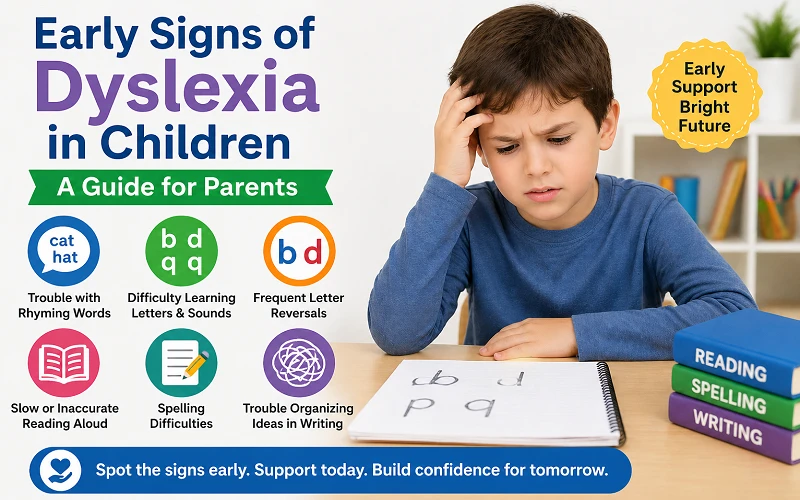
Difficulty recognizing and manipulating rhyming words
Many young children enjoy rhymes in songs and simple books. However, a child with dyslexia may struggle to hear that “cat” and “hat” sound alike. This can be one of the first clues that something feels off with language.
In fact, recognizing signs of dyslexia early often starts with small speech and sound patterns. A child may fail to spot rhymes, mix up similar sounds, or give unrelated words instead of true rhymes. These patterns can appear before formal reading lessons begin.
They may also struggle to break words into parts or blend sounds to form a word. For example, if a parent says the sounds /c/ /a/ /t/, the child may not connect them to “cat.” As a result, reading and spelling later become harder.
Parents and teachers who notice these signs can track them over time. Early attention helps guide next steps and supports stronger reading skills.
Struggles with learning and recalling letter names and sounds
Many children with dyslexia have trouble learning letter names and the sounds each letter makes. For example, they may not remember that the letter “b” makes the /b/ sound, even after repeated practice. As a result, they often confuse letters that look or sound alike, such as b and d or p and q.
In preschool or kindergarten, a child may struggle to sing the alphabet song or name letters in order. In addition, he or she may fail to recognize letters in his or her own name. This pattern can continue into first grade, where the child has difficulty matching sounds to letters.
Because reading depends on strong letter-sound knowledge, these gaps can slow early reading progress. The child may guess at words rather than sound them out. Therefore, parents and teachers should watch for steady difficulty with letter recall, especially if practice does not lead to clear improvement.
Problems with spelling and frequent letter reversals
Many young children mix up letters as they learn to read and write. They may write b instead of d or flip p and q. In early grades, this can be part of normal brain growth.
However, ongoing spelling problems can point to dyslexia. A child may spell the same word in several ways on one page. He or she may leave out sounds, add extra letters, or struggle to match letters with the correct sounds.
Letter reversals alone do not mean a child has dyslexia. Dyslexia affects how the brain processes language, not just how letters look on paper. In addition, children with dyslexia often have trouble learning letter names and blending sounds into words.
If reversals and poor spelling continue past age seven or eight, parents may want to seek an evaluation. Early support can help a child build stronger reading and spelling skills.
Slow or inaccurate reading out loud
A child with early signs of dyslexia often reads out loud in a slow and uneven way. He or she may pause often, guess at words, or skip small words. As a result, the reading does not sound smooth or natural.
The child may also mix up similar letters, such as b and d, or read words in the wrong order. In addition, he or she might struggle to sound out simple words that classmates read with ease. This pattern can appear in kindergarten or first grade.
Accuracy can change from day to day. For example, a child may read a word correctly on one page but miss the same word on the next. Therefore, parents may notice that progress seems inconsistent.
Reading out loud may also cause stress. The child might avoid reading in class or at home because it feels hard and tiring.
Trouble organizing written work and expressing ideas
Some children have many ideas, but cannot place them on paper in a clear way. Their thoughts may seem out of order, and sentences may not connect. As a result, the message feels hard to follow.
A child might jump from one point to another without clear links. In addition, he or she may leave out key details or repeat the same idea. Teachers may notice short, simple sentences that do not explain much.
Spelling, grammar, and punctuation problems often add to this issue. Therefore, the child may focus so much on letter formation or spelling that little energy remains for clear ideas. Written work may look messy or incomplete, even if the child understands the topic.
Parents may also see frustration during homework. The child may speak ideas with ease but produce very little on paper. This gap between spoken and written skills can signal a learning difference, such as dyslexia or dysgraphia.
Conclusion
Early signs of dyslexia often appear in speech, letter knowledge, and early reading skills. Parents who notice patterns such as trouble with rhyme, slow letter recall, or frequent letter reversals should take them seriously and seek guidance from a qualified professional.
Early action matters. With the right support, many children build strong reading and writing skills over time; therefore, clear instruction, steady practice, and patient support at home and school can help them make steady progress.
Please remember: The information here is supportive, not prescriptive. For any serious concerns, checking in with a qualified expert is always a good step.